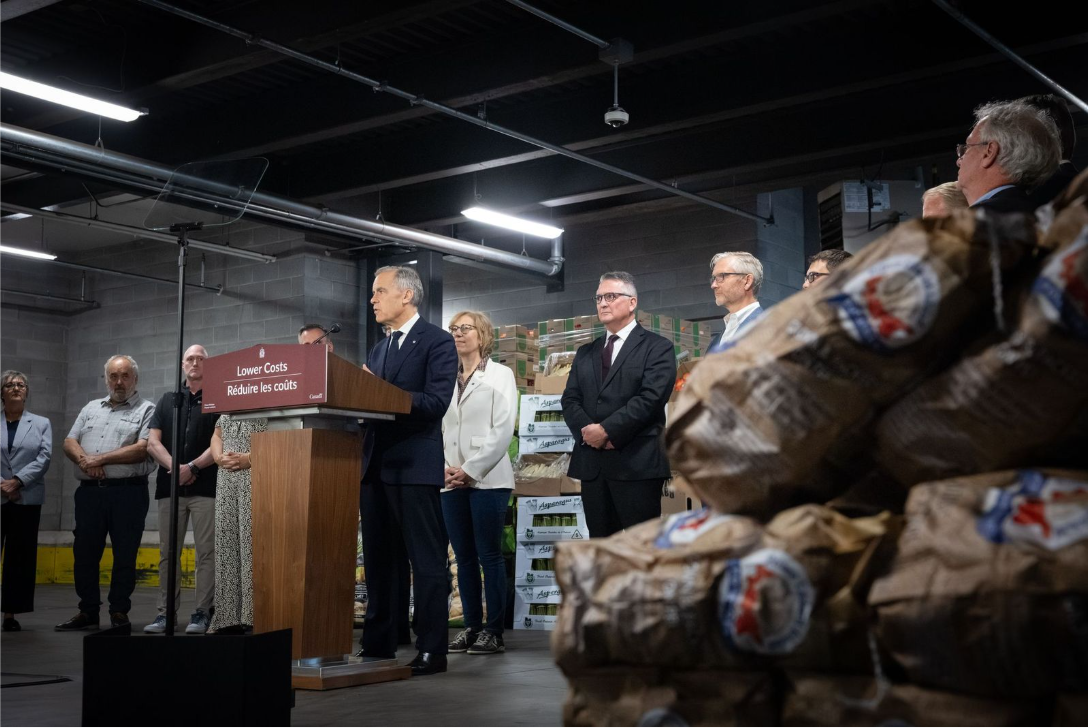
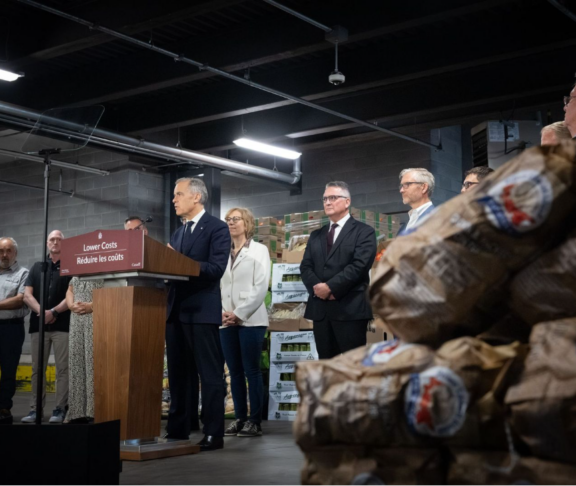
Pictured above: The Prime Minister of Canada, the Right Honourable Mark Carney, accompanied by the Parliamentary Secretary to the Minister of Agriculture and Agri‑Food, Sophie Chatel, and the Honourable Heath MacDonald, Minister of Agriculture and Agri‑Food, during the announcement of the National Food Security Strategy on June 11, 2026. Photo Credit: Daniel Pereira/Office of the Prime Minister of Canada.
As Canada faces growing pressures on food security, productivity, and sustainability, Minister Heath MacDonald outlines the government’s vision for strengthening domestic food production, accelerating agricultural innovation, and supporting producers in building a more resilient and competitive food system for generations to come.
1. What is your vision for ensuring long-term food security while supporting Canadian producers?
We just launched Canada’s first-ever National Food Security Strategy to strengthen Canada’s food self-sufficiency and improve access to affordable, nutritious food for all Canadians.
It builds upon actions the Government has already taken, such as the new Canada Groceries and Essentials Benefit that will be a significant support for more than 12 million Canadians, and the National School Food Program, feeding up to 400,000 more children annually.
Most importantly, the Strategy introduces new actions to provide long-lasting support to Canadian families, producers, independent grocers, and food and beverage processors.
For example, there is $1 billion in new funds over 10 years for a new Food Link Fund to update and create wholesale food terminals, and for new food hubs. This will develop more direct links between farmers and consumers and drive competition in the food retail market. We will also be investing $750 million to dramatically expand year-round Canadian production of fruits and vegetables, including through greenhouses, vertical farms, and other enclosed growing spaces. These will be major contributors to reducing our dependence on imports and long distribution networks outside of Canada, especially in rural and northern communities.
New funds will support the Competition Bureau and Competition Tribunal to increase their capacity to prevent anti-competitive behaviour, and to study competition throughout the food supply chain. The Strategy will also help small and medium-sized processors and innovators modernize, increase productivity, and attract new investment, so Canada can process more of what our farmers grow, create new jobs, and build greater food self-sufficiency.
We will also be helping young farmers, making it easier for them to take over the family farm, either from their parents or from more distant relatives. And we will work to reduce costs and grow the economy while protecting health and safety by cutting red tape and fostering collaborations among all levels of government.
We are taking action to make food more affordable in Canada, while promoting the security of Canada’s food supply for the future.
2. How is the government working with farmers, innovators, and industry leaders to accelerate sustainable agriculture practices across the country?
Canadian agri-businesses are leading the way in creating new solutions to reduce emissions and make agriculture more resilient. The Government of Canada helps producers and innovators explore, test, and scale up their ideas and practices, with multiple programs built to support the industry’s work on sustainability.
Through the Agricultural Clean Technology (ACT) Program, the government is providing farmers and agri-business funding to help develop and adopt the latest clean technologies to reduce greenhouse gas (GHG) emissions and boost their long-term competitiveness. The latest iteration of the program, the $30-million ACT Accelerator, is helping innovators either develop new technologies or scale up the ones that have shown the most promise, contributing to a more competitive and climate-friendly sector.
As well, our On-Farm Climate Action Fund (OFCAF) promotes practices like nitrogen management, cover cropping, or rotational grazing to store carbon and reduce GHG emission while helping the producers’ bottom line. Since 2022, OFCAF has supported more than 8,200 farmers to adopt new practices over 2.9 million hectares across Canada.
Along with the province and territories, our government is also funding the Resilient Agricultural Landscape Program. This $250-million cost-shared program is helping producers conserve and enhance the resiliency of Canadian agricultural landscapes.
3. With growing consumer demand for transparency and locally-sourced products, how can Canada strengthen trust and competitiveness in its food system?
The Canadian food system is one of the best in the world. I know this from my international trade missions, and as the Minister of Agriculture and Agri-Food, my work is anchored in the trust I have in each and every one of its components, from farm to table. When I promote our products abroad, I can count on the stellar reputation of the Canada Brand and on the work of our trade commissioners around the world.
Trust starts at home, in the work of our producers and processors. To support them, our government allocated over $64 million from the Sustainable Canadian Agricultural Partnership to the AgriAssurance Program. It helps them back up their claims of food safety and food quality with real data and assurance systems addressing both the market requirement and the consumers’ expectations of animal welfare, environmental sustainability or traceability, for example.
We are also consulting with Canadians on our Next Policy Framework, a five-year roadmap for the sector supported by transformational federal-provincial-territorial investments. By listening to every stakeholder and every citizen about how to best shape our agriculture and agri-food policy, we are building a future where producers and the value chain keep their businesses strong and competitive, so they can strengthen Canadians’ trust in their local farmers and the food system that feeds their families.
4. What role does innovation—such as agri-tech, data, and precision agriculture—play in shaping the future of Canada’s agriculture sector?
Innovation is a cornerstone of our sector’s success.
As Minister, I want to make sure that the next generation of farmers and agribusiness leaders have the innovative tools and technologies they need to keep driving the sector forward.
Innovation needs investment. Our government has a very strong focus on diversifying sources of capital for our economy. As part of the National Food Security Strategy (NFSS), our government is investing $100 million in our Global Innovation Clusters to establish a Collaborative Food Innovation Fund – bringing the industry to work together though a consortium model to develop and adopt innovation throughout the value chain.
Farm Credit Canada will advance $1 billion to their Agri-food Project Finance Fund to catalyze valued-add, capital-intensive high-potential projects for the Canadian agri-food industry. This adds to the $2 billion they are already investing in Canadian agriculture innovation, aiming to develop data and precision agriculture, with another $5 billion committed by a coalition of private sector partners, for a total investment of $8 billion over the next four years.
This is a generational investment for the agriculture industry. It will allow Canadian producers to use the latest technologies and exploit all the available data to make sure our agriculture sector is profitable, efficient, and resilient and can help us build the strongest economy in the G7.
5. How is your department supporting the next generation of farmers and addressing labour challenges within the industry?
Agriculture relies first and foremost on its people. From business owners to field workers, from mechanics to accountants, the agricultural workforce of the future needs the right mix of skills, youth, new entrants, and under-represented groups.
The Government of Canada contributes to the success of our younger generations through hiring and training programs like the recent Team Canada Strong for skilled trade workers and Youth Employment and Skills Program for agriculture and agri-food workers. For the next generation of farmers and ranchers, Farm Credit Canada also has supports available, from skill building, to planning and financing solutions.
International workers will continue to be an important part of the agricultural workforce, particularly given the labour needs of rural and remote communities. Our government is currently adapting the Temporary Foreign Worker Program to the needs of the agriculture and agri-food sector, for the benefit of both the employers and the employees. We are also working on offering pathways to permanent residence for the skilled temporary workers who are already contributing to communities and working in Canada in specific in-demand sectors, with a focus on those in rural areas.
6. What opportunities do you see for expanding exports, while maintaining strong domestic supply chains?
Canada’s agriculture and food sector has all the ingredients to stand out on the global stage, while continuing to drive our economy here at home.
It’s a challenging time for the sector right now, with market uncertainty, supply chain disruptions, and rising production and transportation costs. Our government has taken a number of concrete steps to support Canadian businesses, including temporarily suspending the fuel excise tax and working to simplify interprovincial trade through regulatory reforms.
Beyond these national measures, the Government of Canada is working to stabilize and expand our trade relationships globally. As Minister of Agriculture and Agri-Food, diversifying our export markets has been a crucial part of my work, including six international missions in the first year of my mandate.
To help Canadian agriculture and agri-food businesses and associations navigate tariffs and trade disruption and promote their products, we have invested an additional $75 million to expand the AgriMarketing Program with the creation of new Market Diversification streams, helping them explore new markets and develop new trade relationships.
And the results are starting to show. Last year, Canada’s customer base for our agriculture, food and seafood exports was the most diversified on record and our exports hit a new record of more than $101.2 billion.
