Innovating Canada


Assem Kroma
Senior Manager, Immersive Technologies and Simulation, Fanshawe College

Jeff Wright
Vice-President, Innovation, Strategy and Enrolment, Fanshawe College
Fanshawe is building AI and XR ecosystems designed to drive innovation across Canada’s evolving industries.
Artificial intelligence is already transforming how Canadians work, learn and do business. Pair it with extended reality (XR) — technologies that include virtual, augmented, and mixed reality — and the possibilities extend even further, from immersive workplace training to healthcare simulation and emergency response preparedness.
But for Canada, the bigger question may be whether we simply use these rapidly evolving technologies or help shape what comes next.
Assem Kroma, Senior Manager, Immersive Technologies and Simulation at Fanshawe College in London, Ontario, believes a shift is already underway.
“Over the past few years, Canada has been more of a receiver, or consumer, rather than a producer of AI and XR innovation,” he says. “Now there’s been a shift, starting with our federal and provincial governments.”
That shift requires building Canadian expertise, research capacity, infrastructure, and talent, and creating an environment where industry and academia can turn innovation into practical, responsible solutions.
Fanshawe is already a key player in this.
Connecting the pieces
The College has created an applied research, multidisciplinary ecosystem around AI and XR, meaning individual projects are not created in isolation.
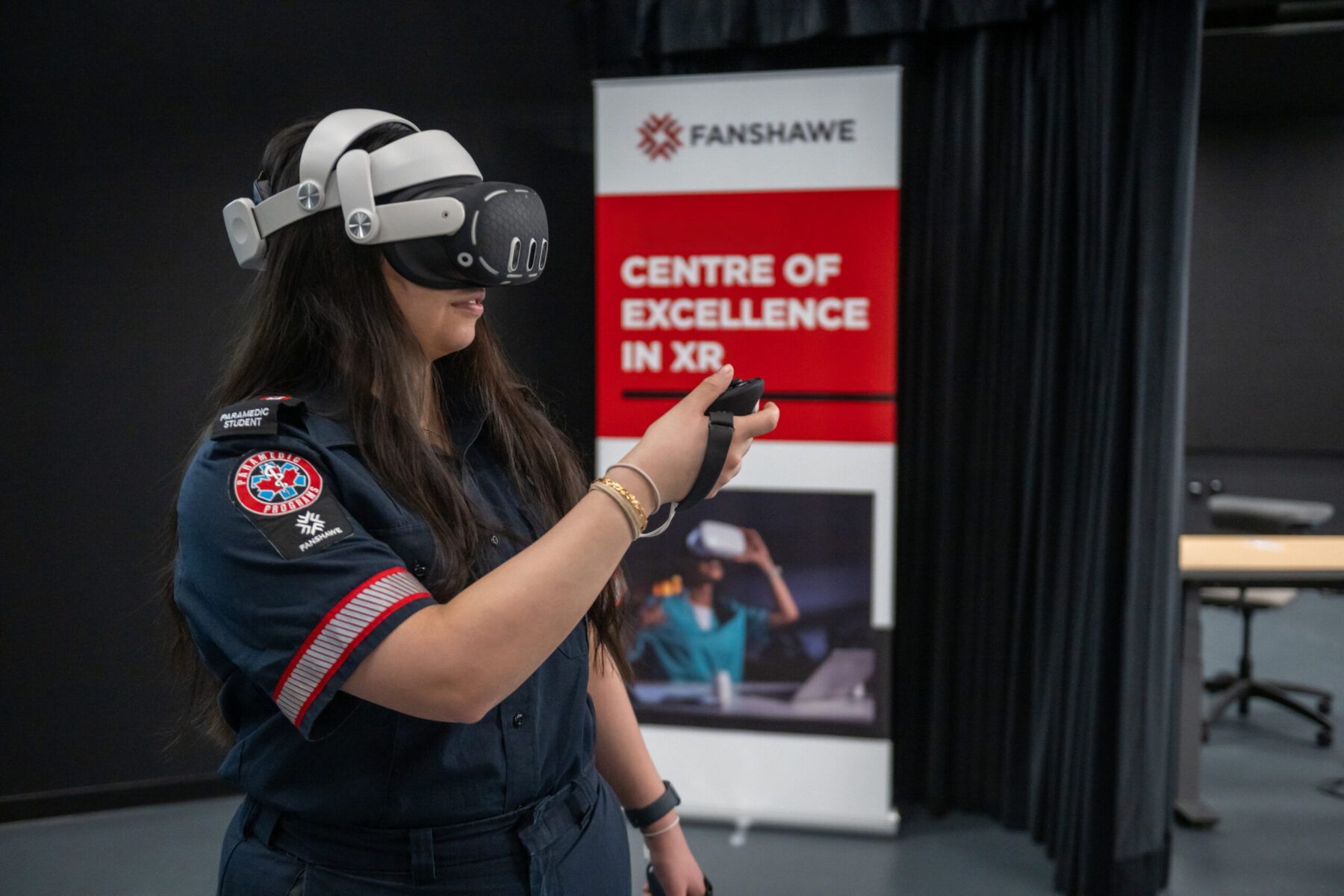
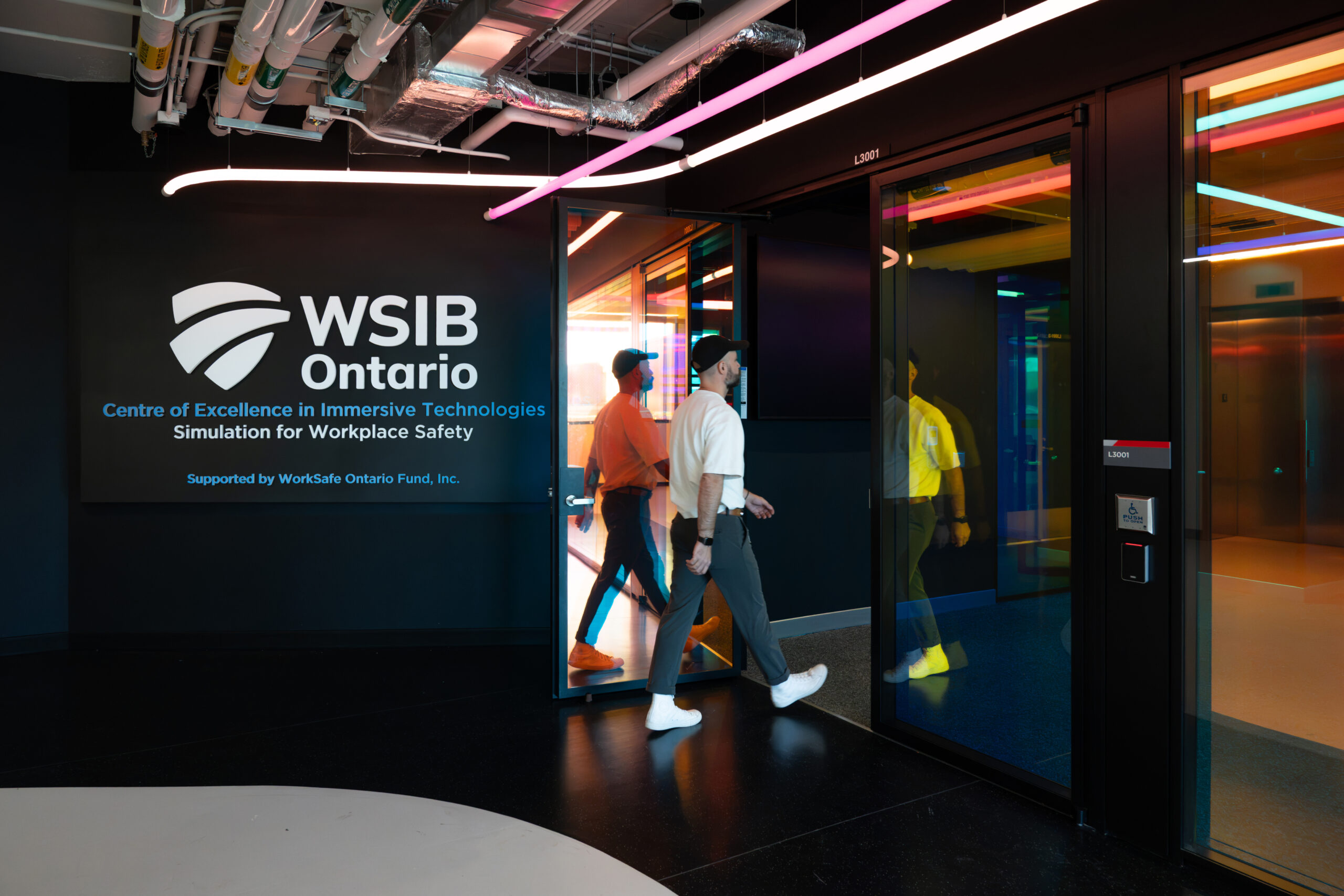
Its facilities include a healthcare centre of excellence, the WSIB Centre of Excellence in Immersive Technologies Simulation for Workplace Safety (public safety) and SafeSkills XR (construction), which is also funded by the WSIB. Its broader infrastructure includes simulation labs, immersive 3D simulation rooms, motion capture and biomechanics systems, XR laboratories and an XR content creation studio.
Expertise developed in one area serves to strengthen another and can ultimately be transferred to new sectors.
For Jeff Wright, Fanshawe’s Vice-President, Innovation, Strategy and Enrolment, that foundation is what makes expansion possible.
“Once you have the infrastructure and staff, then scaling is fairly easy,” he explains. “We bring students across disciplines, for example, health sciences, IT, and design, to create simulations based on need, particularly in high-risk environments.”
Training in a new reality
Traditionally, students may practise de-escalating a difficult situation with a trained actor while a faculty member observes. Fanshawe is developing an AI-driven avatar that responds dynamically to what a student says or does, allowing learners to practise repeatedly and receive feedback.
Students from different disciplines work together on complex, real-world problems—experience that mirrors an increasingly multidisciplinary workplace.
The technology adds an immersive training option difficult to achieve in a classroom: virtually unlimited opportunities to practise independently, make mistakes and try again.
“Students can potentially experience this at home at 3 a.m., fail with nobody watching and then try again,” says Kroma. “This is how people learn best.”
The first version is being designed for the Developmental Services Worker program, but its potential is much broader.
“I don’t think we can name a profession where de-escalation isn’t required,” Kroma adds. “The setting changes. The skill doesn’t.”
The power of partnerships
Through another initiative, funded by the WSIB, Fanshawe is working with Middlesex-London Paramedic Services to develop immersive experiences supporting first responder resilience and mental health. Instead of beginning with what developers assumed paramedics needed, the team began by listening to paramedics themselves.
“We didn’t start with the technology,” says Kroma. “We started with paramedics in a room with sticky notes and a lot of listening.”
Those first responders bring lived experience; clinical psychologists, and healthcare researchers provide oversight; and XR, AI, motion capture, 3D modelling, and game design specialists and students help translate that knowledge into immersive experiences.
It’s a model that reflects what Wright sees as an important role for colleges: supporting industry through innovation while preparing students for the workforce.
“Students from different disciplines work together on complex, real-world problems — experience that mirrors an increasingly multidisciplinary workplace,” Wright says.
Scaling into new sectors
Because the underlying infrastructure and expertise are already in place, Fanshawe sees potential to apply its AI and XR capabilities beyond healthcare, public safety, and construction into sectors such as advanced manufacturing and transportation to start.
It also wants to attract the people who will help build that future. For highly skilled, highly experienced XR and AI specialists, Fanshawe aims to be an employer of choice and a place to work on the latest and emerging technologies in the field.
For industry, the invitation is equally clear: bring the College a problem and explore what can be built together.
If Canada is moving from technology consumer to creator, building the expertise, industry partnerships and capacity to innovate here at home will be critical to determining where AI and XR take us next.
“We welcome people who share the same vision to partner with us because the impact we can have together will be remarkable,” says Wright.
Organizations looking to explore AI and XR solutions, workforce development, or applied research partnerships can connect with Fanshawe College through fanshawec.ca/partnerships or contact Candace Miller at 519-777-9519 or [email protected].