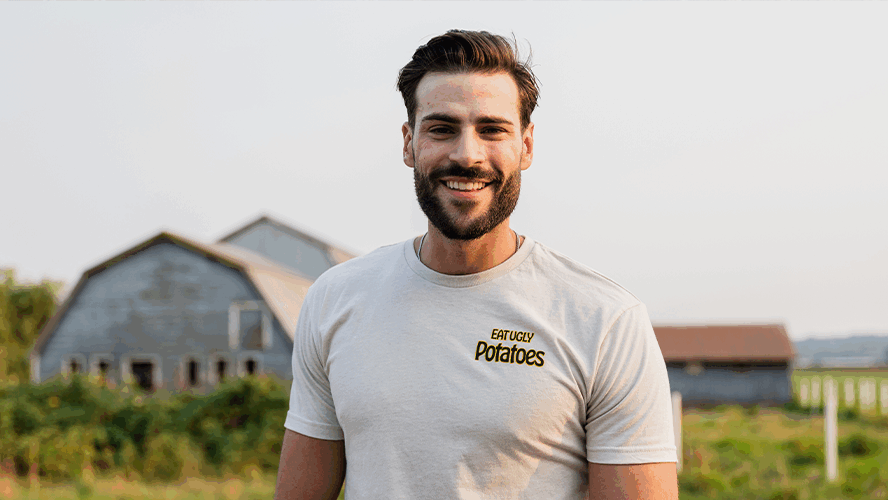
From reviving a family farm to launching Canada’s largest “Ugly Potato Day,” Potato Ty is redefining what it means to be a modern farmer—through technology, social media, and a mission-driven approach to food sustainability.

Can you tell us a bit about your background and how you got into farming?
I grew up on our family potato farm in Cloverdale. From ages 5 to 18, I worked every summer and after school, but at 18 I decided I was done with farming. I went off to university, got a business degree, and then spent five years in corporate America doing sales. Even though the job was good, I started to feel like I was missing a bigger purpose. At 28, I came back to the farm for a one-year trial to give it one last shot. I ended up falling in love with it—the challenges, the ups and downs, and the sense of purpose I didn’t get anywhere else. I’ve been here ever since.
What does innovation mean to you in agriculture and on your farm?
This past year has been the most forward-moving year our farm has ever had. We invested heavily in new harvesting equipment, new packing lines, and new washing systems. We’ve seen firsthand how much more productive we can be when we lean into innovation. But it’s not just buying equipment—it’s hiring the right people who know how to use it and push it further. For us, innovation is how we take a 100-year-old farm and set it up to last another 100.
You’ve built a strong social media presence as Potato Ty. How does that connect to your work on the farm and your approach to innovation?
Social media has been a way for me to encourage people to get into agriculture, and it’s allowed me to show the work we’re doing around food waste and food insecurity. Ugly Potato Days and our donation programs are a big part of that. It’s also connected me with some of the brightest minds in agriculture—from storage experts to genetics companies to robotics teams. I meet with top companies almost weekly. Those relationships give our farm an edge and help us stay on the cutting edge of what’s coming next.
Can you give an example of a project or initiative you’re especially proud of?
Ugly Potato Day is the one I’m most proud of. We started in 2022 giving away potatoes that would normally be sold for under two cents a pound for cattle feed, even though they’re perfectly good to eat. The first event had 12 people. Since then, we’ve run 19 events, partnered with 25 farms, and our last one brought out about 20,000 people. It’s grown beyond anything we expected, and we’re now expanding Ugly Potato Day across Canada.
What do you see as the biggest challenge for agriculture today, especially for young farmers? How can innovation help?
The biggest challenge is access to good, fertile land. A lot of farmland is being developed, and that pushes prices higher and makes it tough for young farmers to get started. The good news is that innovation is increasing yields and helping farmers be more profitable per acre. We’re seeing crops become more resilient and new harvesting and growing systems that make small farms viable. Some people are making a full-time living off one or two acres now. Innovation is giving young farmers a fighting chance.
What advice would you give someone considering a career in agriculture or ag innovation?
I always tell people to start in one of two ways. First, try working for an established farm—learn crop management, get your hands on equipment, and see what part of farming you actually enjoy. Second, start small with gardening. Grow a crop, sell at a farmers market, learn what you’re good at, and learn the sales side.
For those interested in ag innovation, remember that many farms still have an old-school mindset. They need help modernizing. If you can combine agriculture knowledge with strong sales and a belief in the product you’re bringing forward, you’ll go far.
Are there any upcoming projects or initiatives you’d like to share?
Yes—we’re working on selling a product direct to consumer. Most farms operate business-to-business, but we think there’s a real opportunity in building a direct-to-consumer brand. There are good revenue streams and better margins there. More details will come soon, but we believe this is a big part of farming’s future.
