


Industry leaders share how Canada’s AI adoption diverges from global trends and how enterprises can set themselves up for AI success.
Artificial intelligence (AI) is rapidly transforming how organizations all around the world operate, make decisions, and serve customers. In Canada, however, AI adoption isn’t quite on par with global trends. According to new research from data and AI leader SAS, Canadian organizations have embraced traditional analytics and machine learning but have been slower to scale newer forms of AI, like generative AI.
Why is Canada lagging behind our global peers? SAS’ research suggests that many factors are at play, including data silos and fragmentation, and a significant gap between experimentation and strategic, trustworthy integration.
We spoke with three industry experts to learn more about overcoming barriers to AI adoption, how building trust in AI increases tangible ROI, and how private- and public-sector organizations can develop data strategies that’ll set them up for success.


Canada’s Commercial AI Maturity:
Stuck in Experimentation
Ryan MacDonald
Executive Director, Commercial, SAS Canada
Ryan MacDonald, Executive Director of Commercial at SAS Canada, describes “a race toward [AI] maturity” among Canadian enterprises. While lower-maturity organizations use AI chiefly to automate administrative functions and boost productivity, Ryan says mature organizations are using AI to help make decisions with humans in the loop. Banks, for example, are reaching that aspirational level of automating human decisions with the issuance of credit. Achieving this level of AI maturity, however, requires the right “data estate,” the right people, and the right process capabilities. Many are stuck in experimentation. Approximately three per cent of organizations in Canada say they’re in the transformative stage, versus around 10 per cent globally. MacDonald attributes this to data silos and regulatory complexity. “We have a very healthy regulatory domain in Canada that doesn’t let us run ahead of what we believe to be good for society and for Canadians broadly.”

Resources Constraints Force Government to do More with Less
Christine Jackson
Executive Director, Public Sector, SAS Canada
Within the public sector, AI adoption rates vary. “Health care is slower given its legacy systems and patient sensitivity, whereas the judicial system, for example, has a significant appetite for improving processes,” says Christine Jackson, Executive Director of Public Sector at SAS Canada. “There’s a national focus on doing more with less, repurposing folks to more strategic roles while analytics and technology handle high-frequency tasks.”
Jackson points to practical use cases across education, health, and justice — from predicting school staffing needs to optimizing ER flow and justice system operations.
“According to our research with IDC, leaders building trustworthy AI are 60 per cent more likely to double ROI of AI projects.” she says. “AI has become more about the journey than the output. Now we’re asking, is it scalable? Is it well-governed?”

Breaking Down Data Silos to Build Smarter Systems
Brian Jackson
Principal Research Director, Info-Tech Research Group
Data silos are a common barrier to AI maturity. SAS’ research shows that 51 per cent of organizations in Canada report siloed data — nearly four times the global average. Only three per cent have optimized data infrastructure, compared to about 10 per cent globally.
“In Canada, the economy is largely built on traditional industries like financial services, natural resources, and the public sector, where culture tends toward a ‘we’ll do everything ourselves’ mentality instead of cross-functional collaboration,” says Brian Jackson, Principal Research Director at Info-Tech Research Group. “A siloed culture leads to siloed data.”
This “decentralized heritage” results in “a patchwork of legacy systems” with “data basically everywhere.” Jackson says the path forward starts with governance and culture. “Treat data as an enterprise asset, distribute data talent across the organization, and build the trust to share it,” he says.
AI TECHNOLOGIES USED
PERCENT OF RESPONDENTS
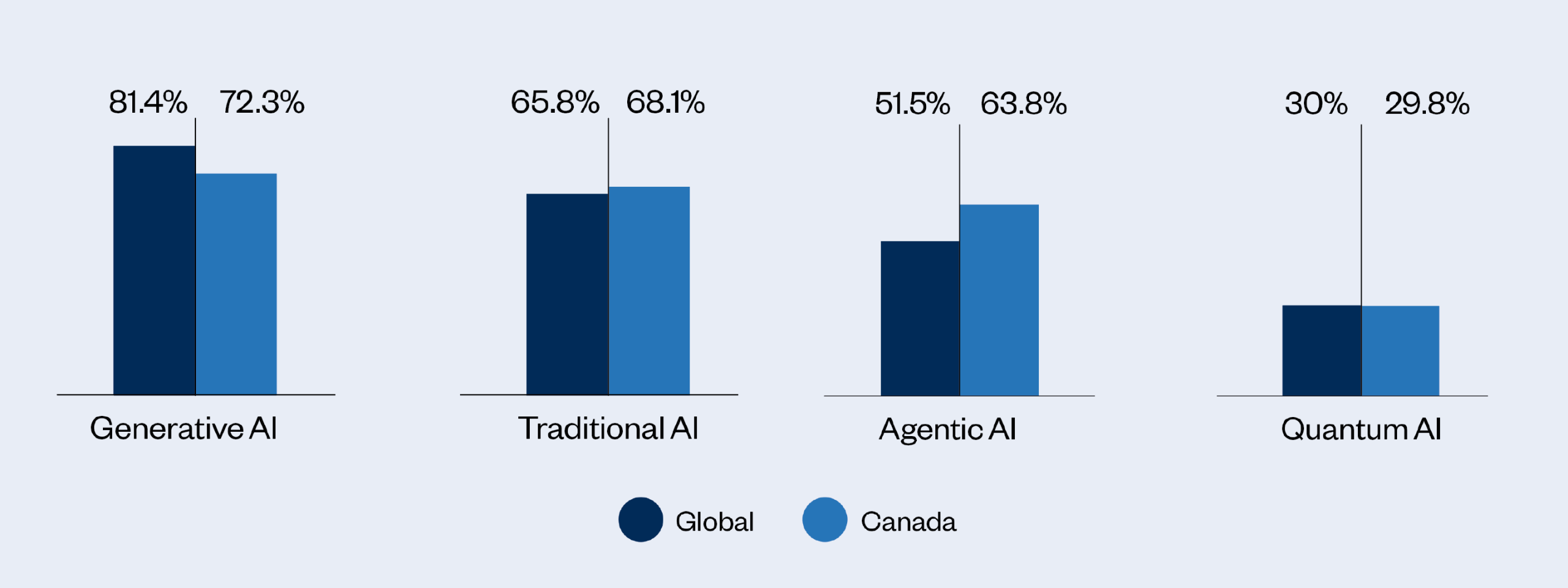
DATA CHALLENGES
IN CANADA
Over half of Canadian organizations report being at the “siloed” stage, nearly four times the global average (13.9%), indicating widespread fragmentation and inconsistent governance.
Meanwhile, only 3% have reached the “optimized” stage, compared to 10.2% globally, suggesting that few Canadian organizations are leveraging advanced, KPI-driven data architectures.
Globally, among those reporting the least investment in trustworthy AI systems, GenAI (e.g., ChatGPT) was viewed as 200% more trustworthy than traditional AI (e.g., machine learning), despite the latter being the most established, reliable and explainable form of AI.
An effective data strategy is the basis for strong AI use cases within your organization. To learn more about how to effectively leverage AI, visit sas.com.
