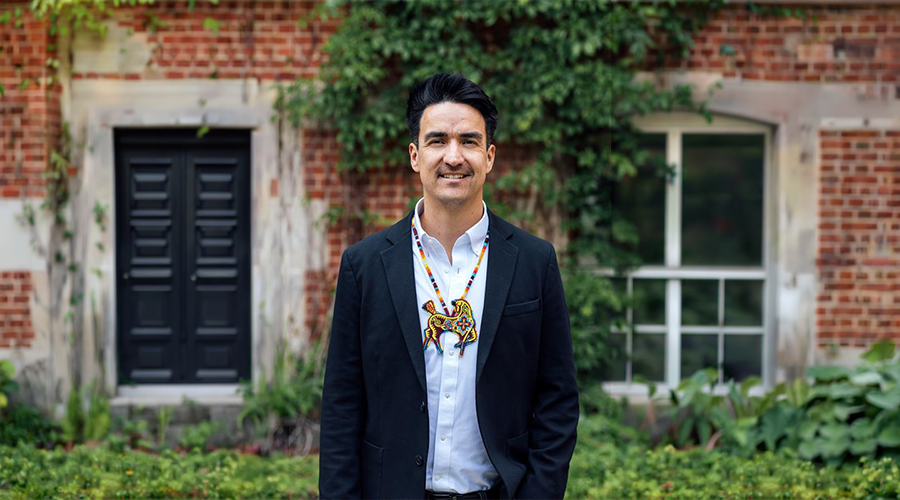
Dr. Grant Bruno
Father to autistic children, a registered member of Samson Cree Nation (One of the Nations that makes up Maskwacîs, Treaty 6 Territory, Alberta, Canada), and Assistant Professor in Pediatrics, University of Alberta.
In this Q&A, Dr. Grant Bruno explores how Indigenous-led research can support autism identification and long-term wellbeing in First Nations communities.

Can you tell us about your research focus and what led you to study autism within First Nations communities?
My research focuses on centering First Nations voices, experiences, and worldviews in how we understand and support autism and neurodiversity. I work with communities to ask what autism looks like through Indigenous lenses, how families experience assessment and services, and how systems need to change so supports are culturally safe and actually reachable. I was drawn into this work through my own family’s experiences with autism and the realization that very little research reflected the realities, strengths, and knowledge of First Nations families. That absence, combined with the harms of colonial systems, pushed me toward community-led research that is accountable to Nations and grounded in Indigenous data sovereignty and relational ethics.
How can research better support early identification and access to services for autistic children in First Nations communities?
Research can better support early identification and access by helping build culturally grounded pathways rather than just importing existing tools and systems. This means developing and adapting screening and diagnostic approaches that make sense in the context of Indigenous languages, parenting practices, and ideas about child development, and then testing them in partnership with communities. It also means mapping and addressing the practical barriers families face, such as waitlists, jurisdictional disputes, travel, and confusing eligibility rules, so that once a concern is raised, there is a clear, supported path from “something feels different” to assessment to ongoing, community-based support. Training local providers and creating community-led early supports (for example, land-based or language-focused programs that also build caregiver confidence around autism) are key ways research can help shift practice on the ground
What areas still need more attention or investment when it comes to autism research in Canada?
In Canada, autism research still needs far more attention to Indigenous-led work, equity, and the full lifespan. There are major gaps in basic information such as accurate prevalence and typical service pathways for First Nations, Inuit, and Métis autistic people, and current systems often under-identify or diagnose later compared to non-Indigenous populations. We also have limited evidence about which models of care work best in rural, remote, and on-reserve settings, especially when they are built from Indigenous knowledge, land-based practices, and community strengths. Beyond early childhood, there is very little research on Autistic Indigenous youth, adults, and Elders, including in education, employment, mental health, and justice contexts. Finally, more work is needed that explicitly connects autism to broader issues like colonization, racism, trauma, and policy design, and that evaluates whether provincial and national strategies actually close gaps for Indigenous families rather than reproducing them.
