

Dr. Ann Marie Vaughan
President & CEO, Humber Polytechnic
While Canada is among the most educated countries worldwide—with 63 per cent of our population holding post-secondary credentials—we lag in economic productivity.
According to Productivity Now, a recently published paper by Humber Polytechnic, Canada’s productivity has been steadily declining since 2020. This trend affects living standards, wage growth, and national competitiveness. “Historically, education and productivity have moved in tandem, and that relationship has been one of the foundational assumptions of modern economic policy,” says Dr. Ann Marie Vaughan, President and CEO of Humber Polytechnic in Toronto, Ontario. “With more than six in ten Canadians holding a post-secondary credential, we have one of the most highly educated populations in the world. That talent advantage represents an extraordinary opportunity for Canada. The question is how we translate that strength into stronger productivity, innovation, and long-term economic resilience.”
Polytechnics can drive economic growth
How are polytechnics are uniquely positioned to help Canada convert its talent advantage into economic growth? “Polytechnics are designed to move at the speed of industry by connecting learning directly to real-world problem solving and applied research directly industry needs,” says Dr. Vaughan. “We generate world-class ideas, and with stronger pathways to scale them, we can translate innovation into meaningful economic impact.”
If we begin progressively increasing applied research funding to reach 10 per cent of overall research investment in Canada, it would supercharge technology adoption, economic diversification, and talent development.
“This alignment allows polytechnics to respond quickly as the economy and labour market evolve rapidly. At Humber, we launched 45 new programs in the past year – each developed in collaboration with industry partners to equip graduates with high-demand skills in emerging sectors. These programs create new opportunities for learners while helping employers access the talent they need to grow, innovate, and scale.”
Through industry-driven programs, applied research partnerships, and the ability to adapt quickly to emerging technologies, polytechnics help translate knowledge into practical innovation and real-world economic outcomes.

Humber is a leader in industry research
Providing education to more than Providing education to more than 76,000 learners, Humber is Canada’s largest polytechnic and a national and global leader in applied research partnerships. In 2025, Humber ranked number one in Canada for industry research income and earned three top distinctions in Research Infosource’s annual ranking of Canada’s Top 50 Research Colleges.
Humber’s polytechnic model goes beyond the traditional academic focus of universities and the job-training mandate of colleges, offering a powerful third option: holistic, future-focused education designed to build knowledge, expertise, and skills in an economy where technological change is unfolding rapidly.
Research partners approach Humber with real operational challenges, while Humber’s expert faculty and students collaborate with industry partners to co-create solutions. Through these collaborations, industry gains access to specialized expertise, student researchers, and advanced equipment through facilities such as Humber’s Barrett Centre for Technology Innovation (Barrett CTI). These partnerships accelerate innovation and shorten development cycles while giving our students the opportunity to work alongside leading Canadian companies tackling real commercialization challenges.
Polytechnics help SMEs to implement
While SMEs form the backbone of Canada’s economy, many lack the R&D infrastructure needed to adopt emerging technologies. Partnerships with polytechnics fill that gap, as Grant Furlane, CEO, LocoMobi World Canada Inc. can attest.
Two years ago, he approached Humber for help in advancing the next generation of a robotic system to support parking and security operations. Funded through a National Science and Engineering Research Council (NSERC) grant, the partnership provided Furlane with access to senior-level engineering students, faculty expertise, and the Barrett CTI.
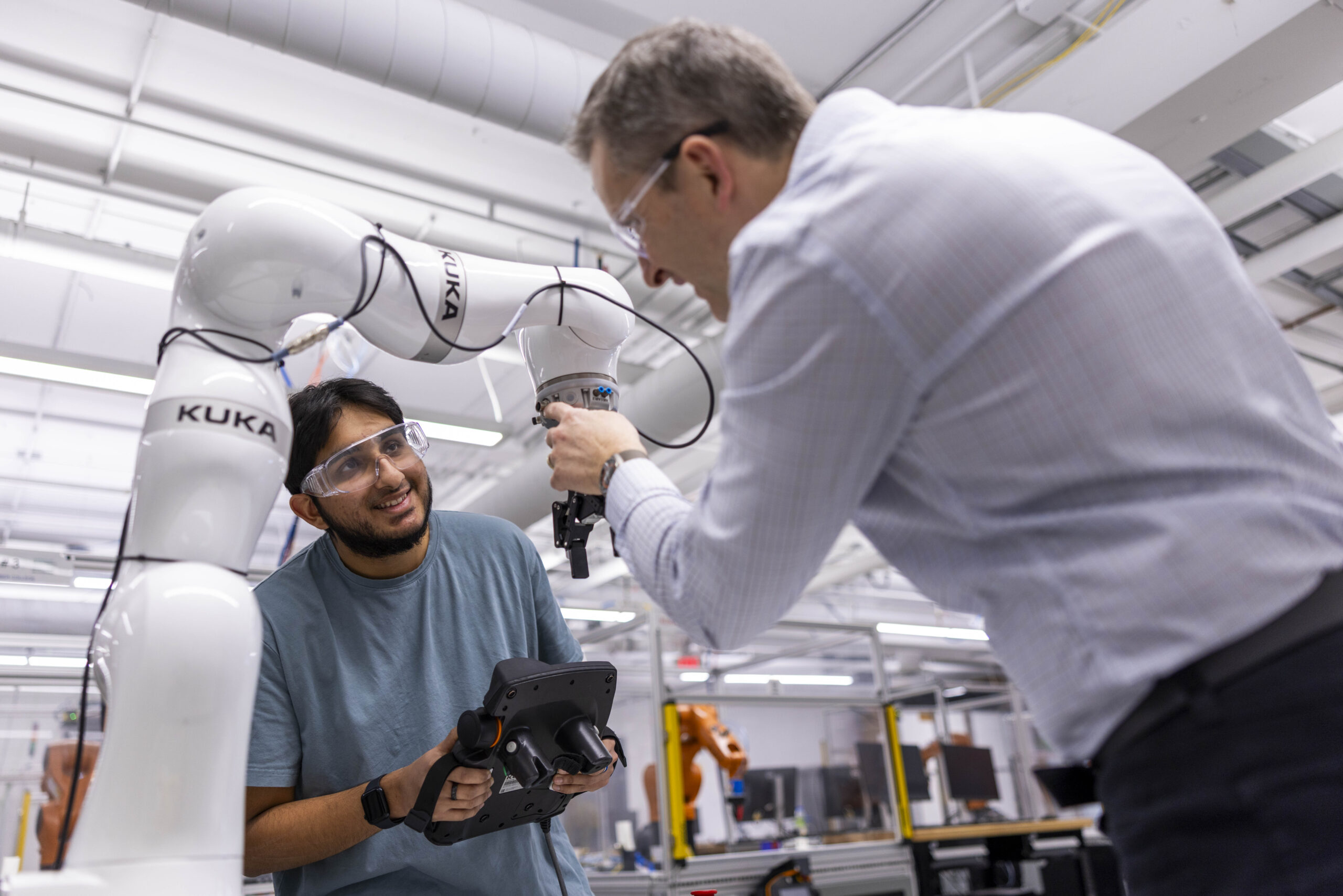
“Partnering with Humber’s research team probably saved us thousands of dollars in time and development,” says Furlane. “The students fully understood the process and had strong technical skills developed through their training in Humber’s program. We ended up hiring the two student leads last year after they graduated,” he says.
Furlane adds that partnerships between industry and post-secondary institutions have become increasingly important. “When I first started my company, we didn’t have partnerships like this with colleges and polytechnics. Now that we do, it’s opening new opportunities for Canadian companies to innovate and grow.
Partnerships turn innovation into economic value
To accelerate technology adoption and innovation, Vaughan says Canada should enhance investment in applied research partnerships between industry and polytechnics.
“Applied research funding for colleges and polytechnics currently represents only a small share of total public research investment,” she says. “Progressively increasing applied research funding to reach 10 per cent of overall research investment in Canada would significantly accelerate technology adoption, economic diversification, and talent development.”
Furlane agrees, adding: “I think there’s potential to see many more successful homegrown Canadian companies emerge because of polytechnics like Humber.”
Learn more about how Humber is advocating for applied research partnerships to be part of our national productivity strategy by visiting humber.ca/productivity-now.
